

There is no fixed expiry date on kinetic-style sand. The material itself does not rot or go bad: what fails first is the moisture balance and the cleanliness of the bin, so sealed and stored properly it stays playable for years, while a regularly used bin is good until the sand stops holding a shape, sheds crumbs it did not shed before, or picks up a smell or visible debris. Watch what the material does in your hands, and the calendar drops out of the decision entirely.
Key takeaways
- Judge a bin by condition, not age: a two-year-old sealed bag can be perfect and a six-week-old open tray can be finished, and both are normal.
- Moisture loss is the most common and most fixable failure; hair, crumbs, and odour are the least fixable and usually mean replacement.
- Never pour water into dry sand, because the water-repellent coating makes it pool on the surface; mist lightly, knead, rest it sealed, and stop when the sand holds a clean cut edge.
- Any musty or sour smell, or colour that transfers onto hands and tools after kneading, ends the bin’s life regardless of how well it still moulds.
- Store sand sealed and away from heat, and never blend fresh sand into a failing batch, because the failure spreads into the new material.
Shelf Life Is Not One Number: The Three Clocks Inside Your Sand Bin
Most people asking how long this material lasts are hunting for a single figure with a date attached. There is no such figure, and the search itself is the problem. Three clocks run inside every bin, each on its own schedule, and the only useful question is which one has run out.
Clock one: sealed stock
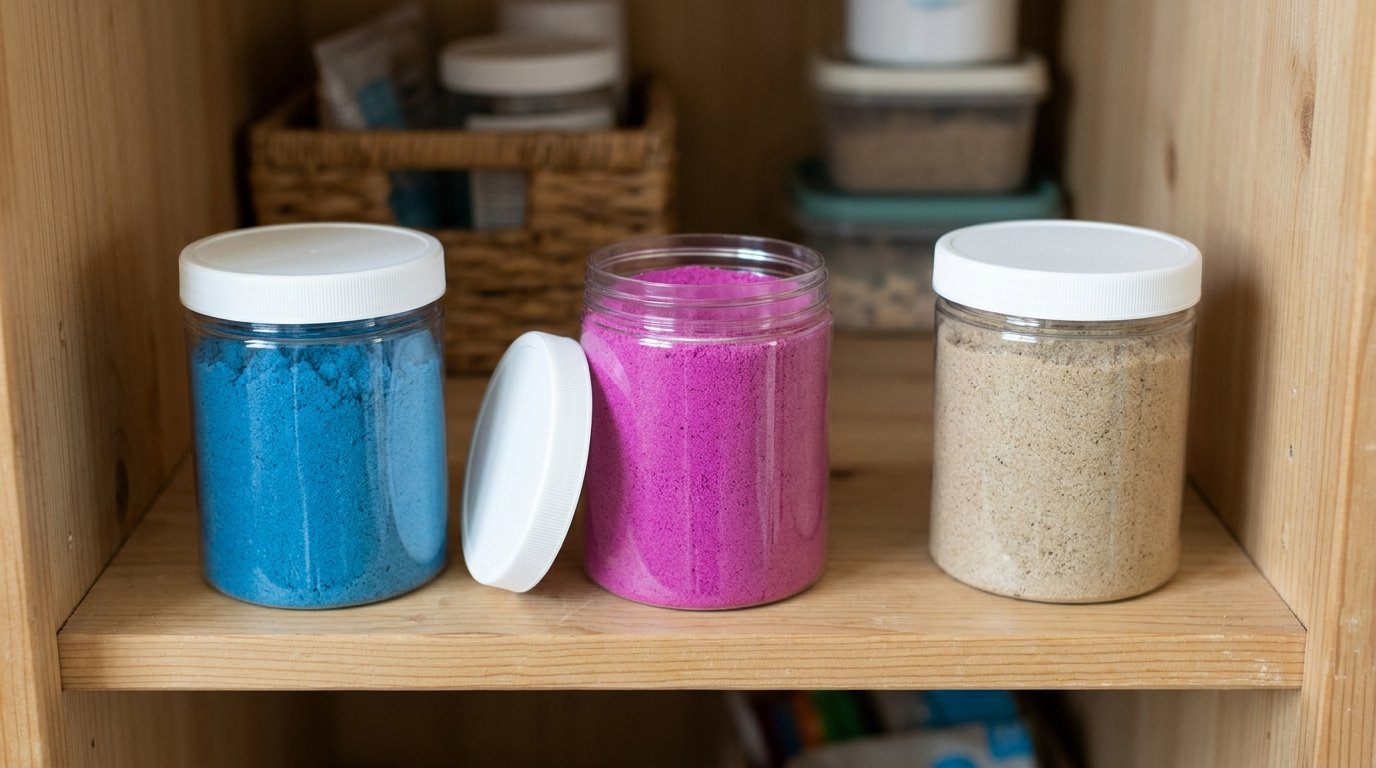
Sand still in its closed bag, jar, or box has almost nothing acting on it. Time by itself does very little. Two things shorten sealed life: a seal that was breached somewhere between the production line and your cupboard, and heat. A shelf above a radiator, a bag left in a car boot through summer, a box in a sun-facing conservatory. If the packaging still closes properly and the storage spot is temperate, an old bag is usually fine.
Clock two: open-bin use
Once the sand is in a tray, it gets squeezed, moulded, cut, and exposed to room air. Now two things run at once: slow moisture loss, which always starts at the surface, and mechanical wear on the coating from repeated handling. This is the clock people mistake for an expiry date, because it is the one that produces visible symptoms.
Clock three: contamination
Hair, dust, crumbs, pet fur, glitter, and the sand from the next tray along. This clock runs on hygiene rather than on the material, and it is the one that most often ends a bin’s life early, long before the sand itself has given up.
What ‘formulated not to dry out’ actually means
IBIZA states its sand is moldable, holds its shape, and is formulated not to dry out, and that it works in different climates, humid or dry. Read that as a claim about moisture equilibrium: the formulation holds its retained moisture far better than plain play sand, so it tolerates the way people really store things. It is not a promise that nothing ever evaporates from an open tray in a heated room. Those are different statements, and the marketing summary collapses them.
It is also worth separating brand advice from product advice. Some shelf-life guidance online is written about the Kinetic Sand brand; IBIZA states its own product is a kinetic-style sand and not that brand. Treat brand-specific storage rules as a comparison point, not as a specification for your bin.
The practical consequence
A bin can be two years old and perfectly fine, or six weeks old and finished. Both are normal outcomes, and neither tells you anything about the other. The word shelf life smuggles in the idea of a date stamp, which is why it keeps misleading people. Condition is the thing you can actually check, and it takes about a minute.
What Actually Breaks Down in a Bin of Moldable Sand
Every symptom a caregiver notices maps onto one of six physical mechanisms. Learn the six and the fix-or-replace decision stops being guesswork, because you can name what you are looking at.
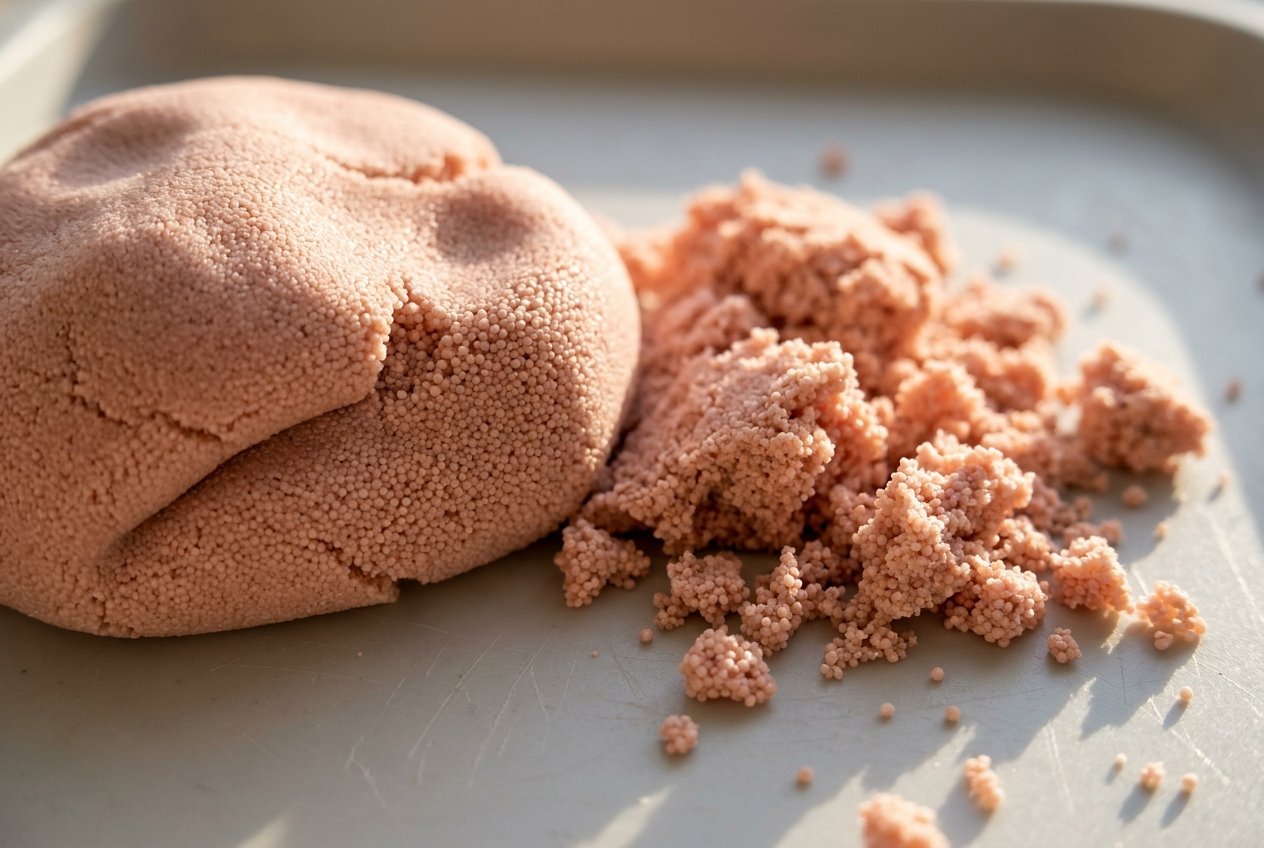
- Moisture loss. The small amount of retained moisture that lets the beads slide past one another leaves the surface first. That is why the top of a tray goes stiff and dusty while the sand underneath still moulds cleanly, and why scraping the dry layer off sometimes solves the whole problem.
- Binder and coating wear. Squeezing and kneading gradually redistribute the additive that creates cohesion. The result is patchiness: some handfuls hold a shape and the next one crumbles, in the same bin, minutes apart. Bulk Magic Sand is built from smooth, round glass beads that feel soft rather than sticky on the hands, and that geometry is what makes the coating behave predictably until it is worked out of position.
- Dust loading. Fine fragments and airborne dust settle into the bin and sit between the beads, stopping them locking together cleanly. The sand feels grainier and looks duller even when the moisture level is fine, which is why misting alone does not fix a dusty bin.
- Fibre and debris loading. Hair, lint, and clothing fibres wrap around bead clusters and physically block cohesion. Nothing dissolves them and nothing re-disperses them. This is the mechanism behind the complaint that a bin never feels the same after a busy term.
- Microbial growth. Any moisture plus any organic material is a habitat: food crumbs, skin cells, plant matter, a splash of juice. This is what produces the damp smell, and it is the one failure on the list that cannot be addressed at home.
- Colour and pigment migration. Over long use, pigment can shift between batches that were mixed together, and dark or saturated colours show dust and lint far more obviously than pale ones. A red tray looks tired at a stage when a natural-coloured tray still looks new.
The ordering matters. Moisture loss is the most common failure and the most fixable. Contamination is less common and largely unfixable. The two also feed each other: sand that has dried out crumbles more readily, and those fine fragments give organic debris somewhere to sit and carry it further into the bin, so a tray that starts merely dry often ends up contaminated as well. That interaction is why a single-trick rescue rarely works. Note also that the water-repellent coating, the thing that keeps the sand from soaking up water, is exactly why the rehydration advice later in this article is about misting rather than pouring.
How Fast Your Sand Ages: Play Intensity, Climate, and Handling
Every setup has a different stressor, and knowing the stressor beats knowing a predicted lifespan, because you can change a stressor and you cannot change a date.
Sort the common setups by what ages them fastest and the picture clarifies. Unopened stock in a cupboard is hurt by heat and a breached seal, so check the closure before you trust your memory of when you bought it. A home bin played with a few times a week and resealed each session ages slowly, because air exposure is brief and the debris load stays low; an occasional refresh of the surface layer keeps it going. A classroom tray used daily by many hands is hit by debris and hard kneading, so plan to rotate stock instead of rescuing one heroic tray forever. An indoor play area adds turnover and grit tracked in from other activities, which produces the shortest usable cycles of any indoor setting. Outdoor and semi-outdoor use is a category of its own, because direct sun and wind pull moisture faster than any room, and leaf litter arrives for free.
Why nobody can give you a number
No responsible supplier publishes a service life for a material whose life depends on how it is kept. The same sand in a sealed jar and in an open tray in a sunny conservatory are two different experiments. A careful keeper will get far more play out of a bin than a careless one. Volume changes the maths too: a 50-pound bag of magic sand is described as filling a small pool, and an operation running at that volume is not maintaining a single bin, it is running a stock rotation.
Humidity flips the maintenance, not the verdict
The company states its sand works in different climates, whether humid or dry, and that holds. What changes is what you do about it. In a dry, heated room the moisture clock runs fast and misting becomes routine. In a humid room moisture loss is rarely the issue; clumping, slower drying after a spill, and damp smells are. Budget two different jobs accordingly: a mister and a quick nightly seal in the dry room, a drying rack, a lid and a check for damp patches in the humid one.
Warning Signs: Fix, Refresh, or Replace?
A decision table earns its keep when your hands are already full of sand. Read down the left column until something matches what you are seeing, then follow the verdict.
| What you observe | What it usually means | Verdict |
|---|---|---|
| Stiff at the surface but still holds a shape underneath | Surface drying only | Fix: knead it and reseal |
| Crumbles into separate clumps, no debris visible | Cohesion disturbed, not destroyed | Fix: refresh the moisture and work it in |
| Holds a shape only briefly, feels light and grainy, leaves a dust film on hands | Moisture loss plus dust loading | Refresh: clean and rehydrate together, then reassess before committing |
| Pale streaks appear where the sand was squeezed | Uneven moisture distribution | Refresh: longer kneading plus a rest in a sealed container |
| Visible hair, lint, or crumbs that cannot be picked out, or grit that never goes away | Debris loaded into the bead matrix | Replace: debris cannot be dissolved out of a bin |
| Any sour, damp, or musty smell, or visible dark speckling | Microbial growth | Replace: this bin should not go back to children |
| Sand transfers colour onto hands, tools, or the tray after kneading | The pigment bond has been compromised | Replace: no amount of refreshing restores it |
| Sticky or greasy rather than crumbly, and no improvement after a rest | Cross-contamination with another material | Replace: the coating chemistry has been altered |
One rule sits above the table: a bin that fails two or more of the replace checks is not worth rescuing. A multi-step rescue on a bin with both a smell and a colour problem is time spent arriving at the answer you already have.
The second rule is about the tempting shortcut. Mixing fresh sand into a failing bin spreads the failure into the fresh material, and you end up replacing the whole quantity instead of a fraction of it. If a portion has failed, remove that portion.
When the Sand Is Just Thirsty: Reviving It Without Making It Sticky
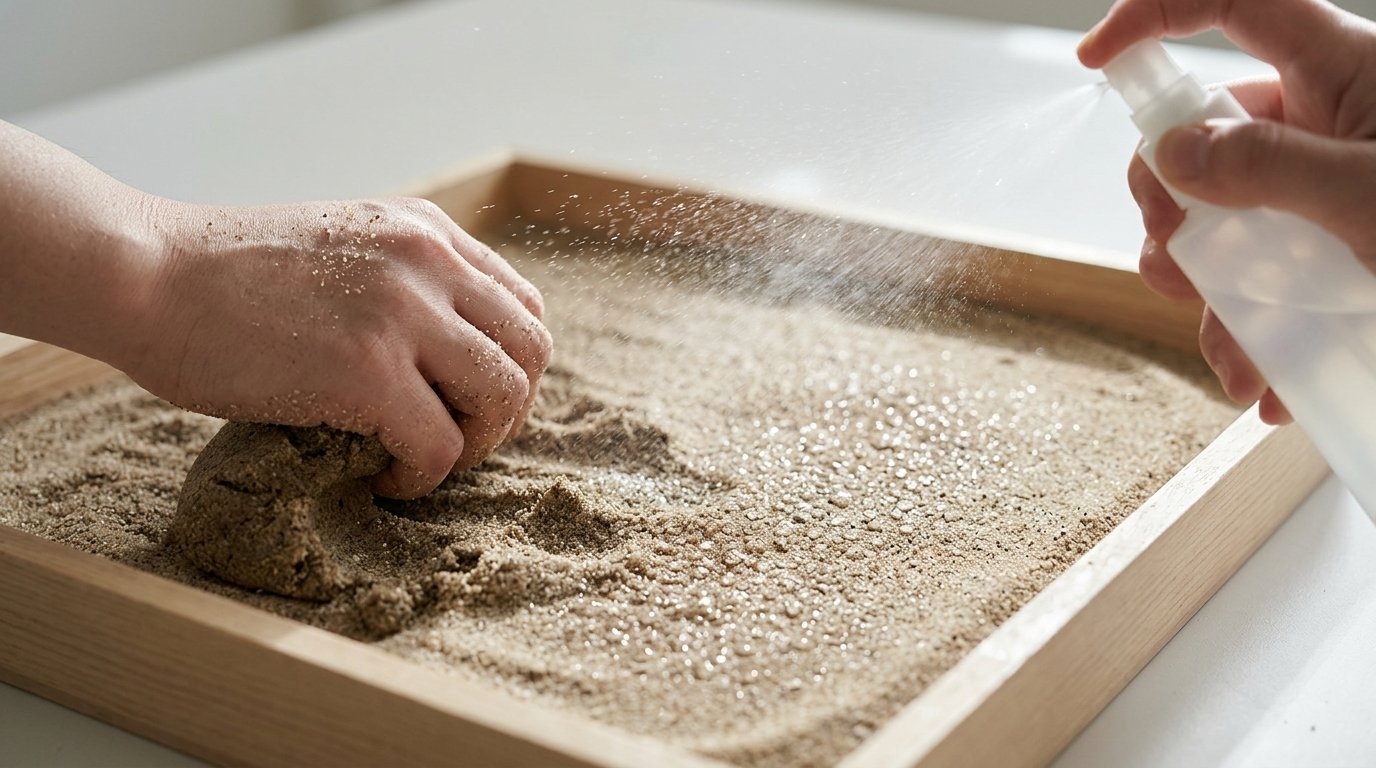
Pouring water in is the mistake that ends more bins than drying ever does. The coating that makes the sand water-repellent does exactly what it was designed to do: water beads on the surface and pools instead of soaking in. A pour therefore produces wet clumps sitting in dry sand, with no mechanism to even them out.
The steps that work
- Mist, do not pour. A light mist over the surface, from far enough back that you are dampening rather than soaking. A household spray bottle is fine; a cup is not.
- Knead for a minute or two before judging. The moisture has to travel between the beads, and only handling moves it there. Sand that feels unchanged after ten seconds of squeezing has not been given a fair test.
- Rest it sealed. Once the moisture is worked through, closing the container for a while lets it even out across the batch. This is what removes the pale streaks.
- Stop at the clean edge. The stopping rule is a cut, not a feeling. When the sand holds a clean edge under a tool and leaves almost nothing on your palm, you are done. Past that point the problem changes from crumbly to sticky, which is a harder problem.
- Work in portions. A large bag revived in one go is nearly impossible to judge, because you cannot feel the middle of it. Split it, treat each portion, then reunite them once every portion passes the squeeze test.
Two cases where reviving is the wrong move
Sand that smells, and sand with embedded debris. Adding moisture to either makes it worse: one feeds what is already growing, the other turns loose grit into a paste that binds to the beads. If either applies, skip to the replace verdict. For the full repair procedures, the dedicated guides on why sand dries out and the seven fixes for sticky sand go deeper than this decision guide needs to.
When Replacement Is the Honest Answer, and How to Retire a Bin Properly
Most advice on the internet leans hard towards saving everything, and that instinct is wrong when children’s hands and faces are in the tray. Some failures are terminal, and recognising them is cheaper than a rescue attempt that drags on for weeks.
Why you cannot rescue a smelly bin
Drying the surface, airing the bin, or adding fresh sand changes what you can smell and leaves the cause sitting where it was. There is no household step that removes what is growing in the matrix. The mechanism behind it is covered in the guide to why kinetic sand smells, and the practical conclusion for this bin is that it has reached the end of its working life.
Why colour transfer is a quality failure
If pigment moves onto skin, tools, and fabric under ordinary handling, the bond between pigment and bead has broken down. That is not a surface blemish you can buff out. It also tells you something about the batch’s history, since long mixing, heat, and contamination all push pigment migration along.
The sunk-cost feeling, addressed directly
Replacing a small quantity of sand is faster and cheaper than a multi-step rescue with an uncertain outcome, and the child gets a bin that behaves properly instead of one that half works. Rescue attempts feel productive because they are active. They are not always the better use of an evening.
Retiring it without making a mess
Small household quantities belong in general waste, sealed in a bag so the material does not shed in transit. Do not flush it, do not put it down a drain, and do not tip it into a garden bed, where it will sit as a visible layer rather than breaking down. Classrooms and play areas apply the same handling at volume: bag each failing tray at the end of the session, label the bag so nobody reopens it hunting for a rescue, and send it out to general waste before the next group arrives.
What Predicts a Long Life Before You Open the Bag
Longevity is decided before the first squeeze. Four attributes do most of the work, and only one of them appears on a label.
- Bead consistency. Smooth, round, evenly sized glass beads pack and slide predictably, which is what allows clean cohesion and less crumb generation over months of handling. Irregular beads with sharp edges wear a coating faster and shed fines. This matters more than any marketing line on the pack.
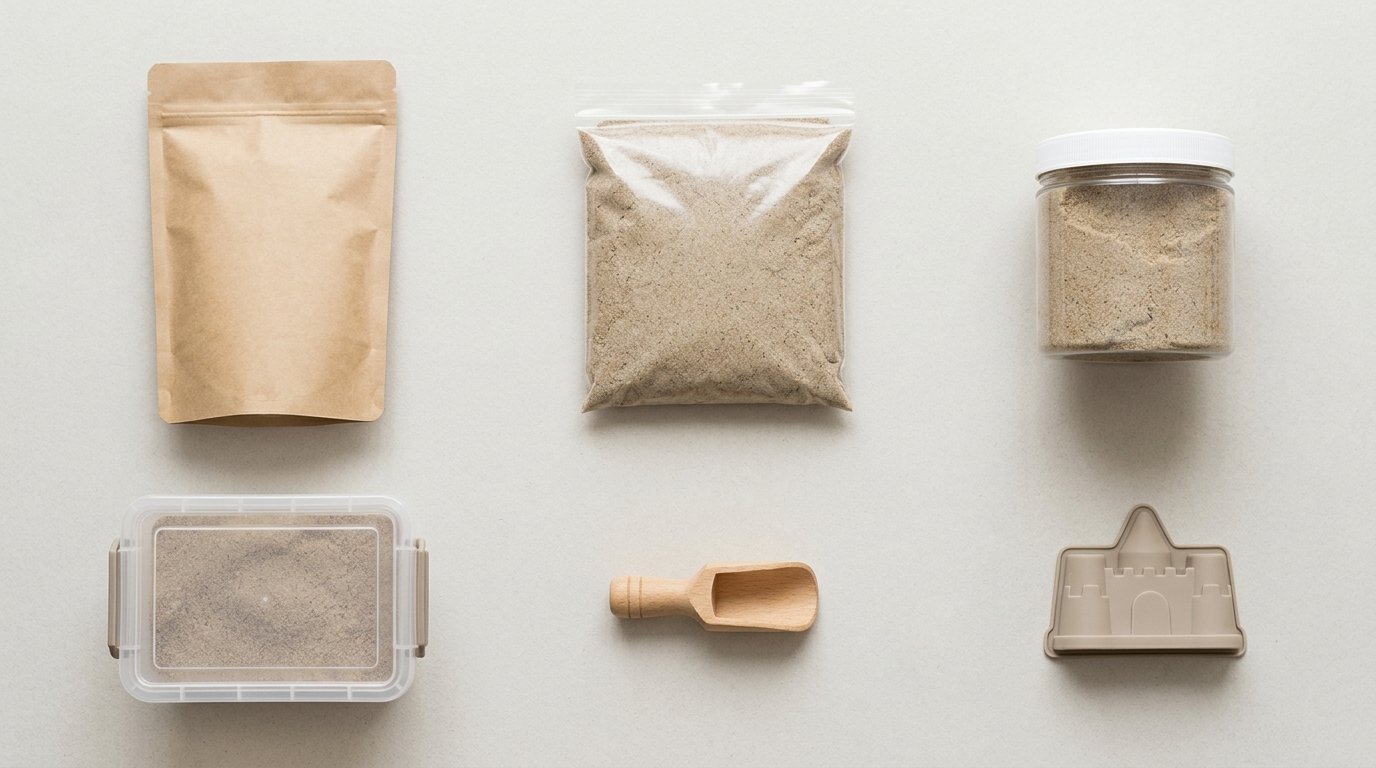
- Resealability. The single most useful packaging feature is a closure that genuinely works. A jar, a lidded storage box, or a heavy zip bag beats a thin bag that gets folded over and clipped, because the fold fails silently. Format options vary widely in this respect: paper bags, plastic bags, plastic boxes, plastic jars, storage boxes, and woven bags all behave differently after the twentieth opening. Choose the format for where the sand will actually live, not for how it looks on a shelf.
- Test documentation. Ask whether it exists and whether it can be shared. Certifications to China 3C, with EN71 for Europe and ASTM for the US, are carried out through SGS for export, and test documents are shared on request. A supplier who can produce paperwork is a supplier whose material claims are checkable rather than verbal, and checkability is what separates a specification from a slogan.
- The evidence behind a longevity claim. When a company states its sand uses a unique glass bead process that makes it stick together well and last longer, that is a comparative manufacturer claim, not a measured number. The plausible mechanism is bead geometry plus a controlled coating process, and IBIZA does state it has carried out over 20 product upgrades. Treat the claim as a direction of travel and inspect the mechanisms yourself.
Colour adds a maintenance variable
Colours behave differently in storage and cleaning. Saturated trays show dust, lint, and pale dried patches far more readily than natural tones, and mixed-colour bins are harder to assess because you cannot easily see contamination against a variegated surface. A multi-colour setup benefits from separate containers, which is also the honest way to keep colours from migrating; the process itself is covered in the guide to mixing kinetic sand colours without making mud.
The Two-Minute Verdict Before You Buy Another Bag
Run these four checks on any bin, in this order, and you will know whether you are looking at sand that needs work or sand that needs retiring.
- Compress and cut. Squeeze a handful, cut it with the edge of a tool, and look at the cut face. A clean edge that holds means the sand is working.
- Rub and look. Rub a little between your palms over a dark surface. What falls tells you whether you have dust, debris, or nothing worth worrying about. Hair and fibres show up immediately against a dark tray.
- Smell the bin before you close it. Any damp or sour note ends the discussion, whatever the squeeze test said.
- Check the seal and the storage spot. Most bins that fail early were stored somewhere warm and left unsealed. Fix the storage before you blame the sand.
Pass all four and you can reseal the bin and stop thinking about dates. Fail one and the triage table applies. Fail two of the replace checks and the honest move is a new batch.
If you want to understand what is actually inside the material, how the surface coating produces that water-repellent, self-clinging behaviour, and where the line sits between a manufacturer claim and a tested property, the explainer on the science behind kinetic sand is the place to start. Understanding the mechanisms is what turns a bin from a thing you guess about into a thing you can read.
Frequently asked questions
Does unopened kinetic sand expire?
No fixed expiry date applies to sealed kinetic-style sand. Time alone does very little to it; the real risks are heat and a seal that was breached in transit or storage. Before you use an old bag, check that the closure still seats properly and that the sand inside still compresses and holds a shape.
Can I put kinetic sand in the freezer to kill bacteria?
No. Freezing does not remove the organic debris that feeds microbial growth, and the condensation that forms as the bin warms back up adds moisture to a material you are trying to dry out. If a bin smells damp or sour, the material cannot be recovered at home and should be retired rather than treated.
Can I disinfect kinetic sand with vinegar or hand sanitiser?
No. Liquids sit on the water-repellent coating instead of absorbing, so they create wet clumps, disturb the moisture balance, and can alter the coating itself. A bin that needs disinfecting is a bin that has already failed the smell or debris checks, and replacing it is the safer answer for children’s use.