

Kinetic sand made from fine sand and a small amount of silicone-oil polymer is generally considered non-toxic for supervised play, but it is not edible and it is not suitable for children who still mouth objects. The asbestos recalls reported from late 2025 onward concerned crushed-rock coloured play sands from specific supply chains, so the real safety question is what your sand is made of and what documentation backs it. Here is how to answer both, and what to do with a tub you already own.
Key takeaways
- Kinetic Sand sold under its own brand name was reported asbestos-free and unaffected in April 2026; the recalls concerned other coloured play sands, largely crushed-rock products sold in Australia, New Zealand and parts of Europe.
- Mouldable sand comes in at least three formulation families, and the asbestos contamination pathway belongs to the crushed-rock one rather than to quartz sand with a silicone coating or to glass-bead blends.
- Non-toxic is not the same as edible. A swallowed mouthful is a choking and blockage question first, and repeated hand-to-mouth play is the reason age guidance exists.
- A toy-safety certificate is a snapshot of a sample, not proof that every batch was tested for asbestos or respirable silica. Ask for a lot number, the laboratory name and the scope of the test.
- If you hold sand from a recalled batch, follow your local authority’s disposal instructions instead of binning it or washing it down a drain.
Has Any Kinetic Sand Been Recalled? What the Asbestos Recalls Actually Covered
The brand most readers are worried about has not been the subject of these recalls. When Galaxus covered the recall wave on 8 April 2026, it reported that the original sand sold under the brand name Kinetic Sand is currently asbestos-free and not affected. That single sentence carries a lot of weight in a news cycle where the product category and the product brand are used as if they were the same thing.
The products that were withdrawn were coloured, mouldable play sands, reported in Australia, New Zealand and parts of Europe. The Conversation identified tremolite in samples and chrysotile in Kadink decorative sand, with the affected goods sourced from China and sold between 2020 and 2025. In Australia, a parent forum points to a recall of an Anko-brand product. Treat forum detail like that as a lead rather than a source, and check any retailer list against the official recall notice before you repeat it.
Why the confusion runs so deep? Because kinetic sand stopped being a brand name and became a category name. Parents, teachers and shop assistants use it for anything that clumps, holds a shape and cleans up easily, so a recall of one crushed-rock product reads as a recall of the entire category.
The Reddit thread title asks how far back a batch has to be before it should be thrown out. Batch age is the wrong variable. A decade-old tub of documented material from a controlled supply chain tells you more about risk than a two-week-old tub with no label and no batch code. Origin, brand and paperwork are the three things that decide it.
Recall lists also change, sometimes within days. Rather than reproducing one here where it will go stale, search your national consumer-safety authority for the product name and batch code. That way you are reading the current list, not a copy of last month’s.
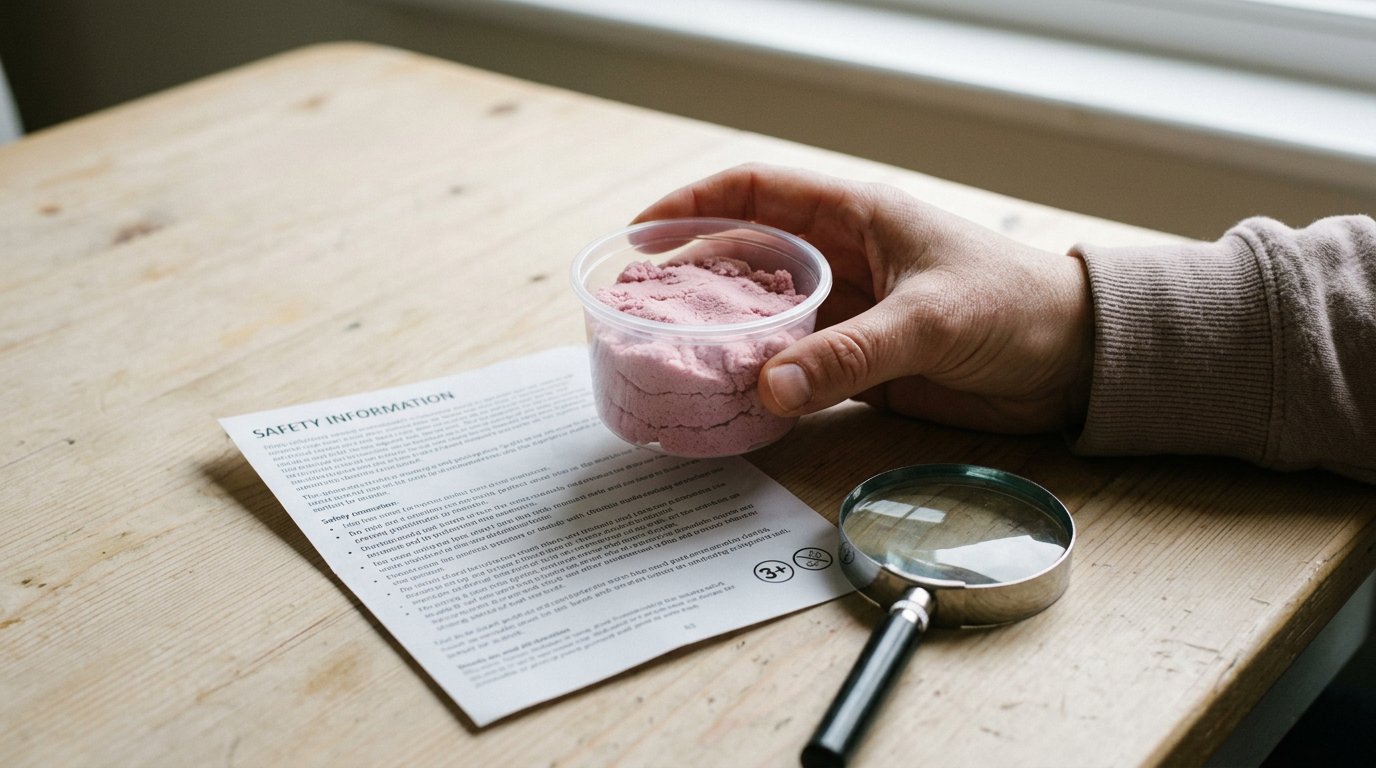
What Is Mouldable Sand Made Of? Three Formulation Families Side by Side
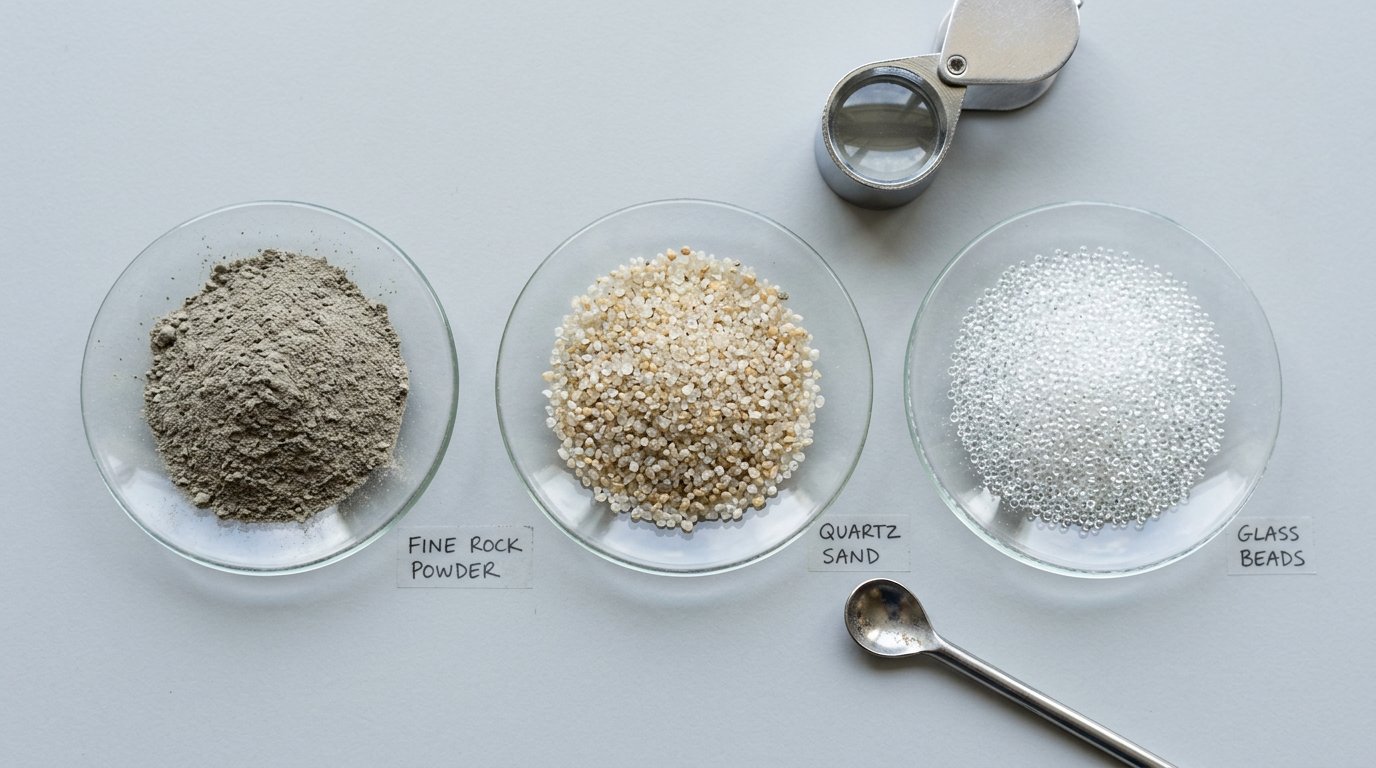
Two sands can feel near-identical in the hand and be built from completely different minerals. Once you know which family a product belongs to, the recall story stops being a category-wide question and becomes a specific one.
Family one: very fine crushed rock powder. Marble or limestone ground to a powder and coated with a binding agent. This is the type described in the Galaxus analysis, and it is where the asbestos finding came from.
Family two: natural quartz sand with a hydrophobic silicone coating. The usual branded kinetic sand formulation, roughly 98% sand and 2% polymer, with polydimethylsiloxane (PDMS) as the silicone oil doing the coating work. The coating is what makes grains cling to each other and slide off skin.
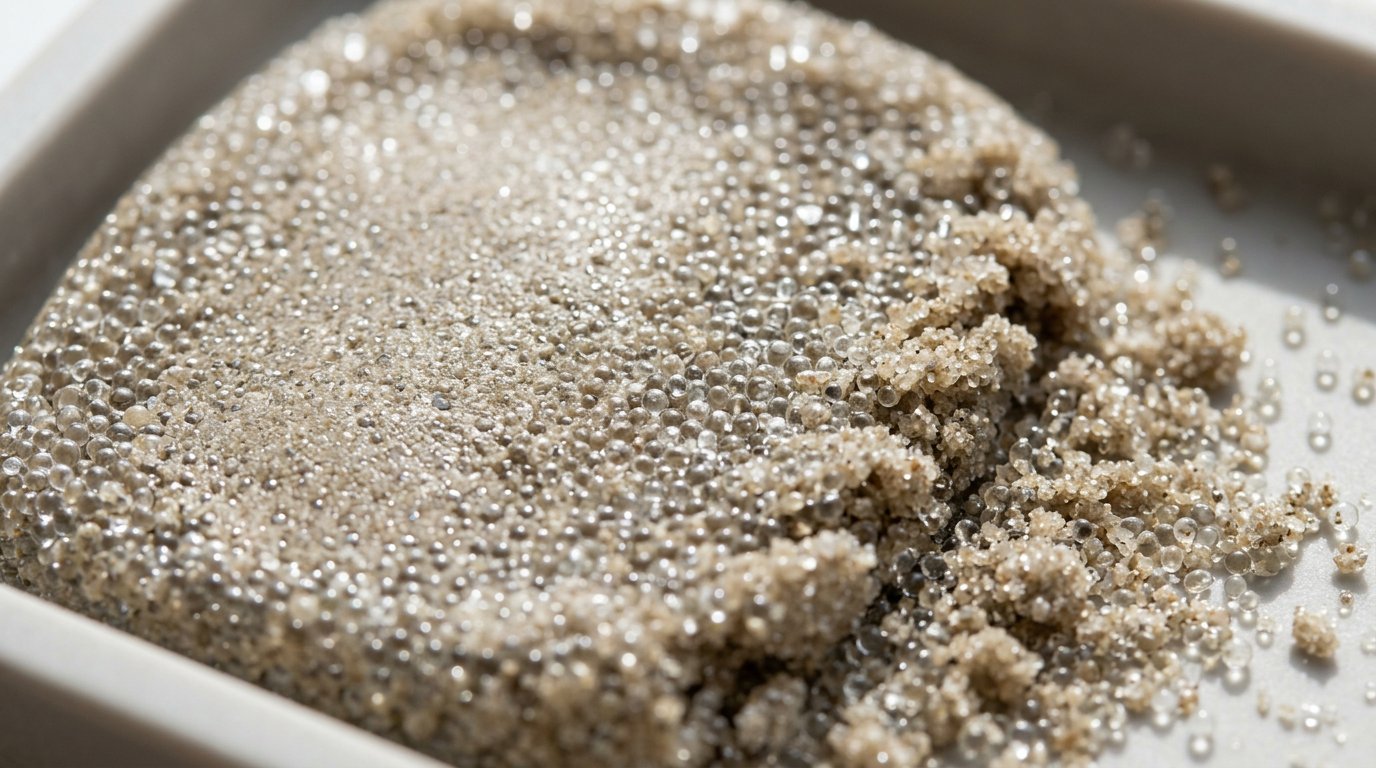
Family three: glass-bead blends bound with wax and silicone. The formulation type Ibiza describes, built from round, smooth glass beads with beeswax and organic silicone. The beads are the structure, the wax and silicone hold the structure in place.
Line the three up and the contamination question changes shape: one family inherits whatever was in the rock, the other two start from different inputs entirely.
The claim you will meet in some comparison content, that all mouldable sand is crushed rock, is simply wrong. But the correction cuts both ways. Squeezing the sand tells you almost nothing. Visual and tactile inspection cannot prove the absence of a contaminant, because the fibres that matter are smaller than the eye resolves. Only a test report can.
For the deeper material comparison, see glass beads versus silica sand, and for the process itself, how kinetic sand is made.
How Asbestos Gets Into a Toy Nobody Meant to Contaminate
Nobody adds asbestos to a toy. As the Galaxus reporting sets out, it arrives inside the rock. Tremolite and chrysotile occur naturally in the same geological layers as marble and limestone, which means a quarry supplying toy-grade rock powder can deliver a contaminant without a single person in the chain deciding to.
Three points in the process decide whether it reaches the finished product. Which quarry the rock came from. How fine the grinding is, since finer powder means more of everything, including fibres. And whether anyone tests each incoming lot. A factory that tests once at the start of a supply relationship and never again is running on an assumption, not a control.
Then comes the part that decides actual risk rather than theoretical risk: respirability. A fibre only matters if it is small enough to be inhaled deep into lung tissue, and fibres bound into a coated, cohesive material release very few of themselves until the material is crushed or pulverised. Routine play rarely supplies that energy. A child grinding a dried clump to powder, or a workshop cutting and sanding finished pieces, is a different scenario from pressing shapes in a tray.
Latency explains why authorities act on odds this long. The Conversation notes that asbestos-related lung cancer and mesothelioma typically appear 20 to 50 years after exposure, so no regulator can wait for outcomes before deciding.
Add the legal asymmetry and the picture gets stranger. Some contexts operate a five per cent labelling threshold for asbestos content. EU and Swiss law take a zero-tolerance position, where a single fibre makes a product hazardous. For a buyer reading a label, the practical consequence is that the word on the tub tells you which rule the seller answered to, not how clean the rock was. A threshold rule permits content up to the limit and requires no warning below it, so the same powder can pass one regime and fail the other without a word changing on the packaging.
How Worried Should Parents Be? Where the Regulators Disagree
Two competent authorities looked at the same product set and did not reach the same conclusion, and pretending otherwise is where public trust gets lost. Belgium’s Sciensano called the risk negligible. Germany’s Federal Institute for Risk Assessment said the data was insufficient to support that judgment. Both readings are defensible when the exposure data is this thin.
The reassurance that travelled furthest came from an oncologist writing in The Conversation: the odds of developing an asbestos-related disease from any exposure in this scenario are very low. Read the scope before you carry that sentence into a different context. It applies to the Australian product set at the fibre concentrations found there, sold through the retailers named in that recall. It does not describe a generic tub bought at a market with no origin and no batch code.
What neither side can offer is a personal risk estimate. There is no medical test for individual exposure risk, so a trip to the GP after ordinary play adds very little beyond reassurance.
So here is the calibrated position. Low probability, not zero. No exposure level that regulators accept as safe. Those two facts together point to one sensible action: stop using a product that appears on a recall list and dispose of it the way your local authority instructs. They do not justify alarm about a documented product that is not on any list.
Notice what this section has not done: it has not told you whether the sand in front of you is safe. Nobody can do that from a photograph or a description. The next four sections are about what evidence would actually settle it.
Ingestion, Skin and Eye Contact: What Happens in Everyday Play
The exposure route that matters most in a house with a toddler is not inhalation. It is the fist that goes into the mouth while you are loading the dishwasher. Almost none of the recall coverage addresses it.
Non-toxic and edible are different words for a reason. A swallowed mouthful raises two mechanical questions before any chemical one: is the airway clear, and can the volume block the gut. Those are the reasons age guidance exists, not toxicity data.
The binder in a typical branded formulation is PDMS silicone oil. Whether a given product uses a food-grade version of that material is a formulation detail, and it has to be documented for the specific product rather than assumed from the category. Some manufacturers describe their grade as food-safe; that description is theirs, and the supporting specification is the part worth seeing. Colourants, fragrances and secondary additives vary between manufacturers, and the plainest formulations usually carry the fewest unknowns. Magic Sand is described as odourless, which removes one variable that parents often react to first.
If a child swallows some sand
- Wipe the mouth out and offer water.
- Watch for choking, coughing, gagging or vomiting.
- Call a poison control centre or a doctor if a large amount went down or any symptom appears.
- Do not induce vomiting, and do not work from a dose threshold you found online.
Skin contact is rarely an issue. The hydrophobic coating means the sand does not wet the hands, so it brushes off rather than clinging. The usual complaints are dryness and residue in the creases of the palms. Sensitivities to a colourant or a fragrance are possible, so washing hands after play is standard practice rather than a precaution reserved for sensitive skin.
Eye contact is an irritation question. Fine particles in the eye call for rinsing with clean water, and a child who keeps rubbing should be seen by a clinician.
Repeated hand-to-mouth play is the pathway that actually matters for under-threes, and it is the reason the age guidance in the final section is built around supervision level rather than around the material itself.
Dust and Glass Beads: The Airborne and Small-Part Questions
Dust and asbestos are separate questions, and folding them together makes both harder to reason about. Dust is a general property of any very fine particulate, and how much of it goes airborne is governed by physics you can control.
For quartz-based fine sands, the hazard of interest is respirable crystalline silica, the fraction small enough to reach the deep lung. Four variables decide how much of it lifts off the tray: whether the coating is holding the grains together, how damp the material is, the energy of handling, and ventilation. Pouring from shoulder height, crushing dried clumps and sweeping with a dry broom all add energy. A tray with a lip, sand kept slightly cohesive rather than bone dry, a damp cloth instead of a broom and an open window subtract it.
What glass beads change
Glass microspheres are round, smooth and near-uniform, so they behave like tiny ball bearings. That is exactly why a bead-based sand flows when you tip the tray and then packs when you press it. Round particles carry no sharp edges, which is the structural difference from a crushed-rock powder, and the glass microsphere technology behind this approach is patented. Ibiza’s 30 years of glass-bead research and development is where that design came from.
The honest framing is that shape and coating are the design basis, not a dust-free guarantee. No particulate material is edge-case free, and a claim of zero risk from any supplier should make you ask harder questions, not fewer.
Small parts are the question parents ask next. Beads are tiny, so they fall under the same rule as any loose play material for children under three: supervised use, or none. Check the floor and the cuffs of clothing after a session, and retire a batch that looks dusty with loose beads or holds visible debris.
What Does Safety Testing Actually Cover? Reading the Paperwork
A certificate is a photograph of a sample. Buyers, and plenty of teachers, treat it as a guarantee about a factory, a year of production and every substance inside the product. That gap between what the document says and what people assume it says is where the real risk sits.
A toy-safety standard typically sets chemical, physical and mechanical requirements, and the exact scope depends on which standard is named and which age grading the toy was tested against. It is worth reading the scope page rather than the logo.
What a compliance claim does not automatically prove: that every batch was tested, that asbestos or respirable crystalline silica was inside the test scope, or that an independent laboratory did the work. What it does prove is that a sample from a defined production point met a defined set of requirements on a defined date.
The checklist for teachers and buyers
- A recent test report, referenced to a batch or lot code, so the document maps to the goods you received.
- The testing laboratory’s name, and its accreditation if that matters to your procurement rules.
- The scope: which substances, which method, which components.
- Manufacturer name and address on the label, not only a distributor.
- The raw-material source, meaning which quarry or which bead supplier.
Red flags are consistent across categories. No brand and no origin. No batch code. A generic non-toxic claim with no standard named behind it. An unusually low price attached to colour claims nobody will document.
On our own paperwork: magicsandfactory states that its Magic Sand complies with China 3C, SGS, ASTM and other international safety standards, that it meets American and European safety standards, and that the company lists 15+ certifications on its site. Those are company statements, and the useful next step is to request the documents for the specific product you are considering. For how process control works upstream of the certificate, see quality control in moldable sand manufacturing.
What Is a Good Age for Kinetic Sand? A Decision Framework Instead of a Verdict
Age guidance printed on a box is a minimum, not a supervision plan. The label governs, and within that, the right question is how closely an adult can watch and how often hands end up in a mouth.
Under three, or still mouthing objects
Not recommended for unsupervised play, and a poor fit for a child in the thick of mouthing. If you use it anyway, keep the quantity small, play on a tray at table height, stay within arm’s reach and wash hands afterwards. The deeper breakdown is in the guide to choosing kinetic sand by age and sensory needs.
Preschool
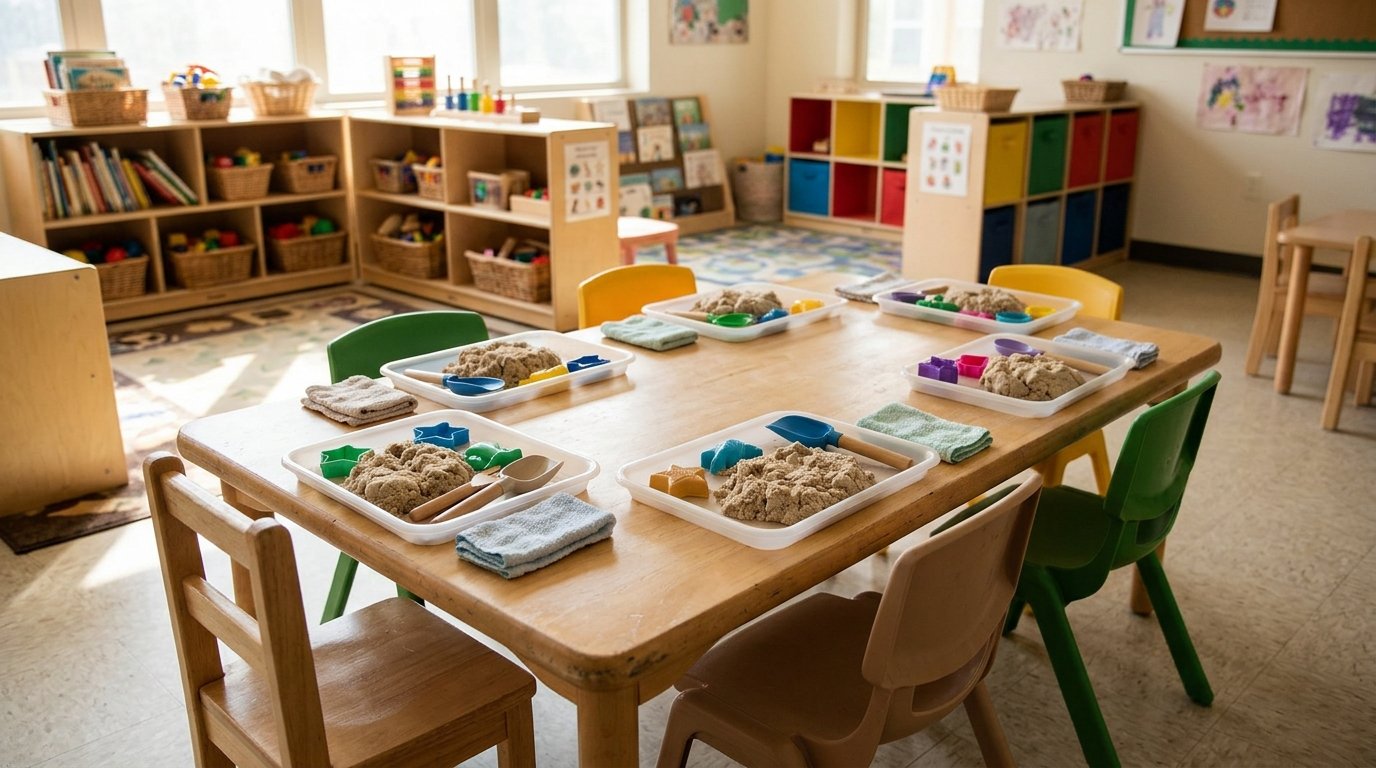
Supervised tray play works well. One tray per child in group settings, hands washed before and after, no food or drink within reach, and a damp cloth rather than a brush for cleanup.
School age
Independent play with simple hygiene rules. Children this age can manage containment and cleanup themselves, which is most of the risk control.
Home versus classroom
Classrooms need logistics rather than warnings: a labelled container per colour, trays with a lip, a stack of damp cloths, and a clear signal for when the session ends. The reason teachers bother is that the material gives immediate tactile feedback, rewards slow repetitive movement and builds hand strength through squeezing and shaping, which is why it turns up in occupational therapy and calm-down corners.
Everyday hygiene
Sand stored damp grows mould and picks up odours. Replace it if it smells, changes colour or holds visible debris, and keep the container closed between sessions.
An unlabelled batch of unknown origin
Stop using it, put it out of children’s reach and contact the retailer or your national consumer-safety authority for guidance.
Disposal
If your product is on a recall list, follow the local authority’s instructions. The Conversation’s Australian guidance was to double-bag and tape unopened containers and take them to an asbestos waste facility rather than kerbside, and to wipe loose sand with a wet cloth while masked. Those instructions are Australian and local rules differ. For sand that is not affected, do not wash it down a drain, because sand clogs plumbing. Bag it and bin it.
If you would rather switch materials altogether, the durability comparison in kinetic sand versus Play-Doh versus slime covers the realistic alternatives.
Your Safety Checklist, and What to Ask a Supplier Before You Buy
Here is the version you can act on in the next ten minutes, whether you are holding one tub or evaluating a shipment.
- Identify the formulation family. Crushed rock powder, quartz sand with a silicone coating, or a glass-bead blend.
- Check brand, origin and batch code on the label. No batch code means no traceability.
- Set age and supervision rules before the tub is opened, not after the first mouthful.
- Keep the hygiene routine simple and consistent: tray, hand-washing, damp cloth, closed container.
- Retire anything unlabelled, recalled or visibly degraded.
If you are buying for a school, a nursery chain or a retail range, the answer you want to a documentation request is specific. A named laboratory, a lot number that matches your invoice, a date, and a scope that lists the substances tested. An answer that arrives as a scanned logo with no scope is a red flag dressed as a certificate.
Two habits carry most of the weight. Match the document to the goods, by lot code and date. Then decide what you will do when a document does not arrive, because a purchasing decision made before that question comes up is the one that holds.
Frequently asked questions
What can ruin kinetic sand?
Excess water is the fastest way to ruin it, because it overwhelms the hydrophobic coating. Leaving it uncovered dries it out, mixing colours permanently blends them, crumbs and pet hair contaminate it, and heat or direct sun degrades the binder. Store it in a closed container at room temperature and add water a few drops at a time if it stiffens.
What can I use instead of kinetic sand?
The practical alternatives depend on the sensory input you want. Play dough gives resistance and holds finer detail, slime gives stretch and flow, cloud dough gives a crumbly mouldable texture, and dry sand or water beads suit pouring and scooping. Each has its own age guidance, choking profile and cleanup burden, so match the material to the child rather than to the activity photo.