

Moon sand is flour or cornstarch held together by oil, while kinetic-style sand is real sand grains coated in a polymer binder. Oil lets flour clump only while it is under pressure, so moon sand crumbles at the edges the moment you let go, whereas the binder forms bridges that flex and hold, so moldable sand keeps whatever shape you press into it. That single difference predicts shelf life, dust, residue, mouthing risk and how much of the bin ends up on your floor.
Key takeaways
- Moon sand is flour or cornstarch plus oil; kinetic-style sand is mineral sand plus a polymer binder, and the ingredient panel tells you which one you are holding.
- Oil gives flour compressive grip only while you press, so moon sand keeps a ball and loses a chimney, while a binder keeps molded edges and short vertical walls after you let go.
- Heat-treat raw flour before mixing a sensory batch; it is a food-safety step, and untreated flour has no business near a mouth.
- A homemade batch typically degrades within about a month as food oil oxidizes, separates and picks up moisture, while mineral moldable sand has no food content to spoil.
- Match material to setting: mouthing toddlers and crumbly dramatic play suit a flour batch, while preschool tables, Montessori trays and calming corners suit a binder-based sand.
Is Moon Sand the Same Thing as Kinetic Sand? What Is Actually in Each Bin
Read the ingredient panel before the product name. Moon sand in everyday use means a food-based mix: flour or cornstarch plus a small amount of oil. Kinetic sand means mineral sand plus a binder. Everything else in this article follows from that split, and the label on the lid does not always match what is inside the tub.
What moon sand usually means
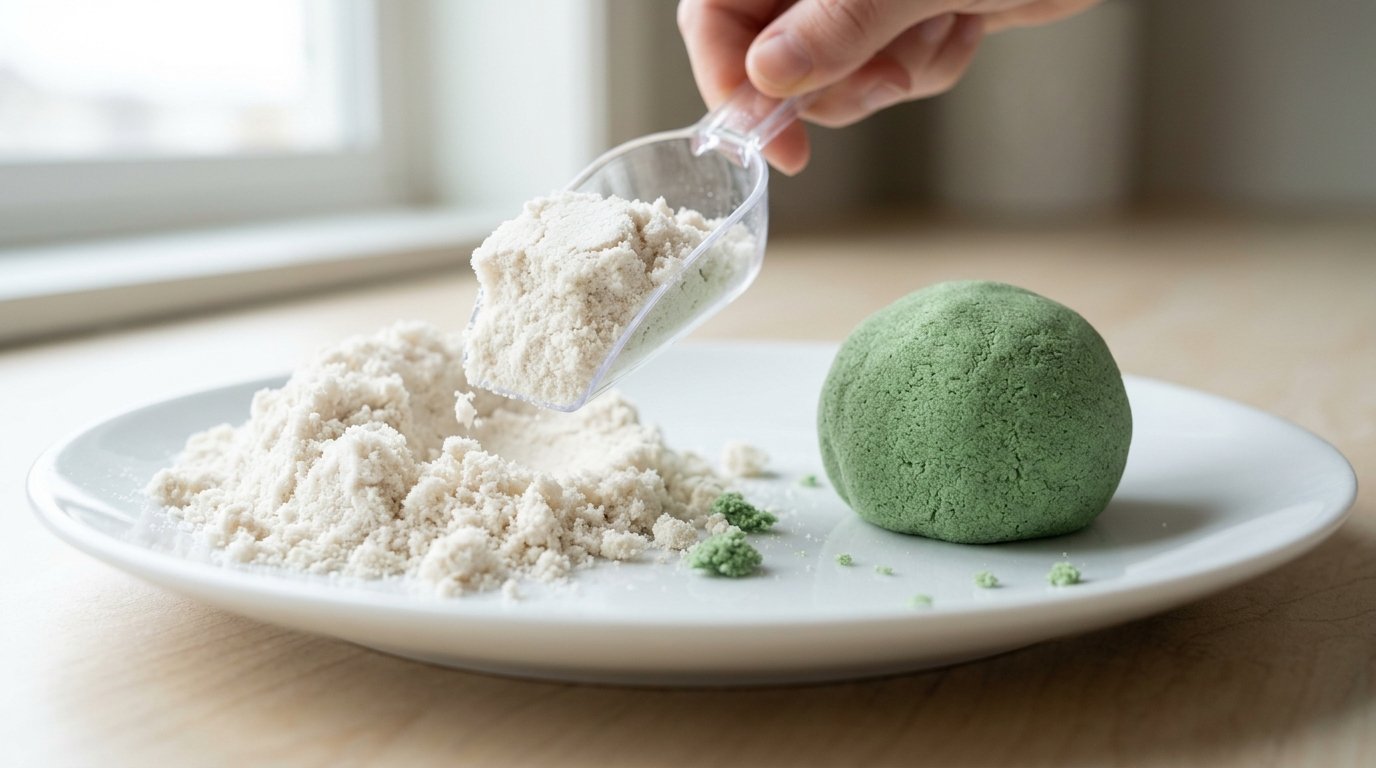
A grain or a starch plus a spoon of oil, mixed until it looks like crumb. The word started as a home recipe and then became a product name, which is why the same two syllables sit on a homemade bin and on a tub on a shop shelf. Tub-and-bucket products sold under a moon sand name can be a different commercial material, so read the panel. If the first ingredient is wheat flour, cornstarch or baking soda, treat the contents as food.
What kinetic sand usually means
Mineral sand plus a polymer binder that bridges the grains. The phrase is also a brand name, Kinetic Sand by Spin Master, so generic use of the term is loose and worth flagging when you compare two tubs side by side. IBIZA describes its own moldable sand as a kinetic-style sand and not the Kinetic Sand brand, which is the honest phrasing for any lookalike.
Where cloud dough, moon dough and sand clay sit
Cloud dough and moon dough are near-synonyms for the flour-and-oil mix, and swapping those words changes nothing in the bin. Sand clay is a separate material that behaves on its own terms, and the sand clay vs magic sand vs kinetic sand comparison covers that family properly rather than repeating it here.
The one question that sorts any tub
Is the material food-based or mineral-based? Answer that and you have already answered shelf life, residue, mouthing risk and cleanup, before you read a single review. A food-based material spoils and dusts, while a mineral one does not rot but still ends its useful life once it is contaminated.
One more variable worth knowing is the grain itself. Moldable play sand sold commercially may be made with glass beads rather than quartz or beach sand, and the difference shows immediately in the hand. IBIZA makes its moldable Magic Sand from glass beads, and describes its bulk material as smooth, round glass-bead sand that is soft and not sticky to hands.
Why One Crumbles and the Other Holds Its Shape: Two Different Mechanisms
The two materials fail at completely different things, and that tells you what each one is holding together.
Moon sand: grip that exists only under your hand
Flour and cornstarch particles are small and irregular, and a film of oil coats them. The film lets the particles slide past one another, then grip weakly while pressure is applied. Release the pressure and the grip is gone, because nothing is left pulling the particles back together.
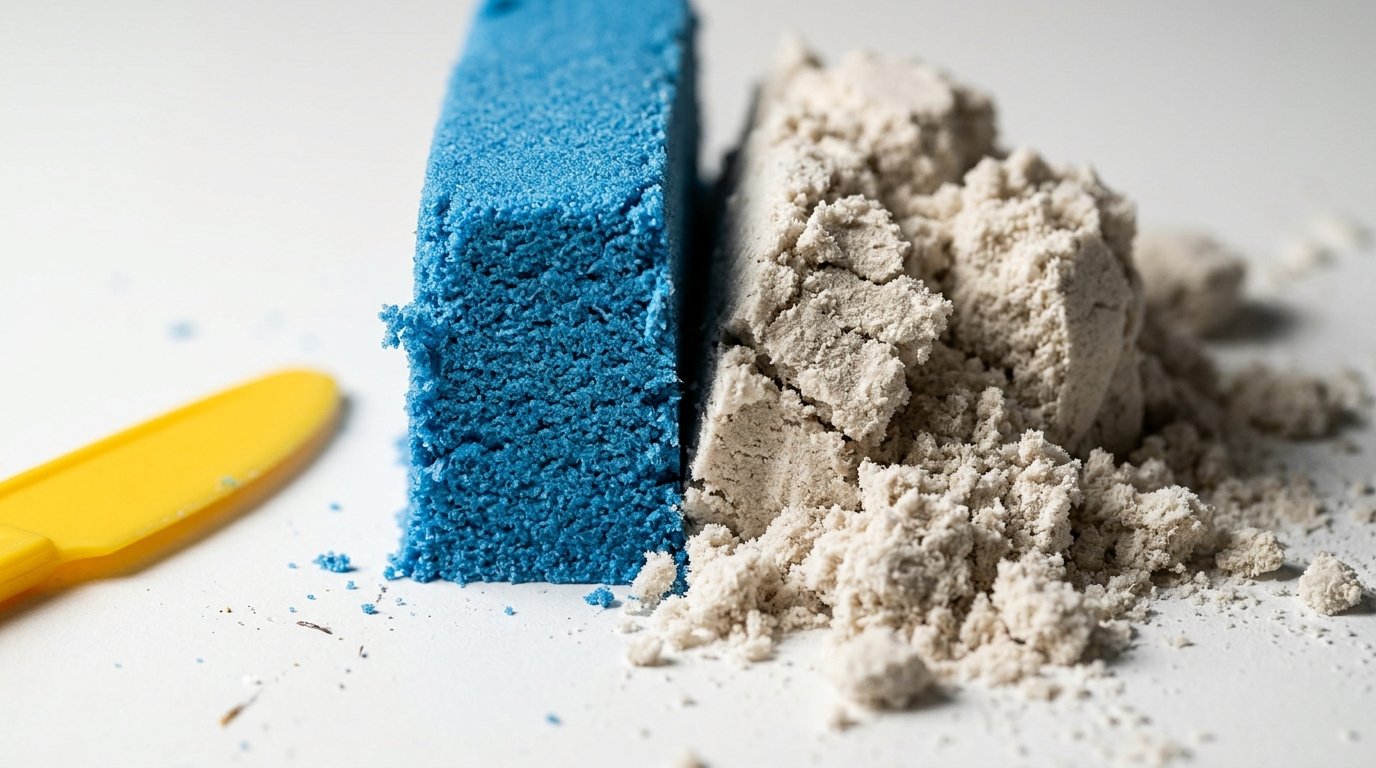
That is what crumble means in practice. The material has compressive strength under your palm and almost no tensile strength, so an overhanging edge shears off instead of holding, and a wall taller than two fingers slumps at the base.
Moldable sand: bridges that survive the release
Here hard, rounded sand grains are joined at their contact points by a binder that flexes. The mass can be pulled, stretched and torn, and it rebounds, which is why a pressed star keeps its points and a short vertical wall stands on its own. IBIZA states its sand is moldable, holds its shape and is formulated not to dry out, and that a specialized coating makes it water-repellent enough to stay dry underwater.
Particle shape does part of the work
Rounded grains release cleanly from a mold and from skin. Fine flour packs into cracks, creases and pores and leaves a powdery film behind. Same hand, same pressure, different residue.
The third case: damp play sand
Water’s surface tension holds a genuinely good castle together, and that hold disappears as soon as the water evaporates. It is a temporary version of the same physics, which is why a beach bucket and a kitchen bin can both hold a shape for twenty minutes and only one survives the afternoon.
Where the half-truth lives
Moon sand does not hold a shape the way a molding material does. It holds the shape you have just pressed, then loses definition as oil migrates and flour takes up or gives off humidity. For the full treatment of why cohesion fails, read cohesion failure in moldable sand.
Side by Side: Texture, Shape Retention, Residue and Mess
Put your own bin, your own floor and your own sensory preferences next to this table. The rows are the ones that decide whether you still enjoy the material on day three.
| Criterion | Moon sand (flour plus oil) | Kinetic-style moldable sand |
|---|---|---|
| Feel | Silky, powdery, faintly greasy | Dense, smooth, cool, faintly damp without wetting the skin |
| Shape holding | Keeps a ball, loses a chimney | Keeps crisp mold edges and short vertical walls |
| Stretch and tear | Snaps apart | Pulls into a strand before it separates |
| Hands and surfaces | Oil film that shows on dark fabric and unfinished wood | Clings to itself and brushes off hard surfaces readily |
| Airborne dust | Puffs when disturbed, which matters in a shared room | Minimal |
| Smell after a month | Stale oil note | Unchanged |
| Best for | Smashing, scooping, crumbly dramatic play | Cutting, molding, detail work that gets moved |
Residue is the row people underestimate. A dry cloth does not lift an oil film, it spreads it, and the mark stays until the surface is treated for oil rather than for sand. For surface-by-surface methods, the guide to cleaning kinetic sand out of carpet, fabric, hair and hard floors covers what actually works.
How to Make Your Own Moon Sand (and the Step Most Recipes Skip)
Most published recipes get the ratio right and stay silent about the one step that matters for safety. The mixing itself is short: a base, an oil, then a correction pass until a squeezed fistful behaves.
The steps
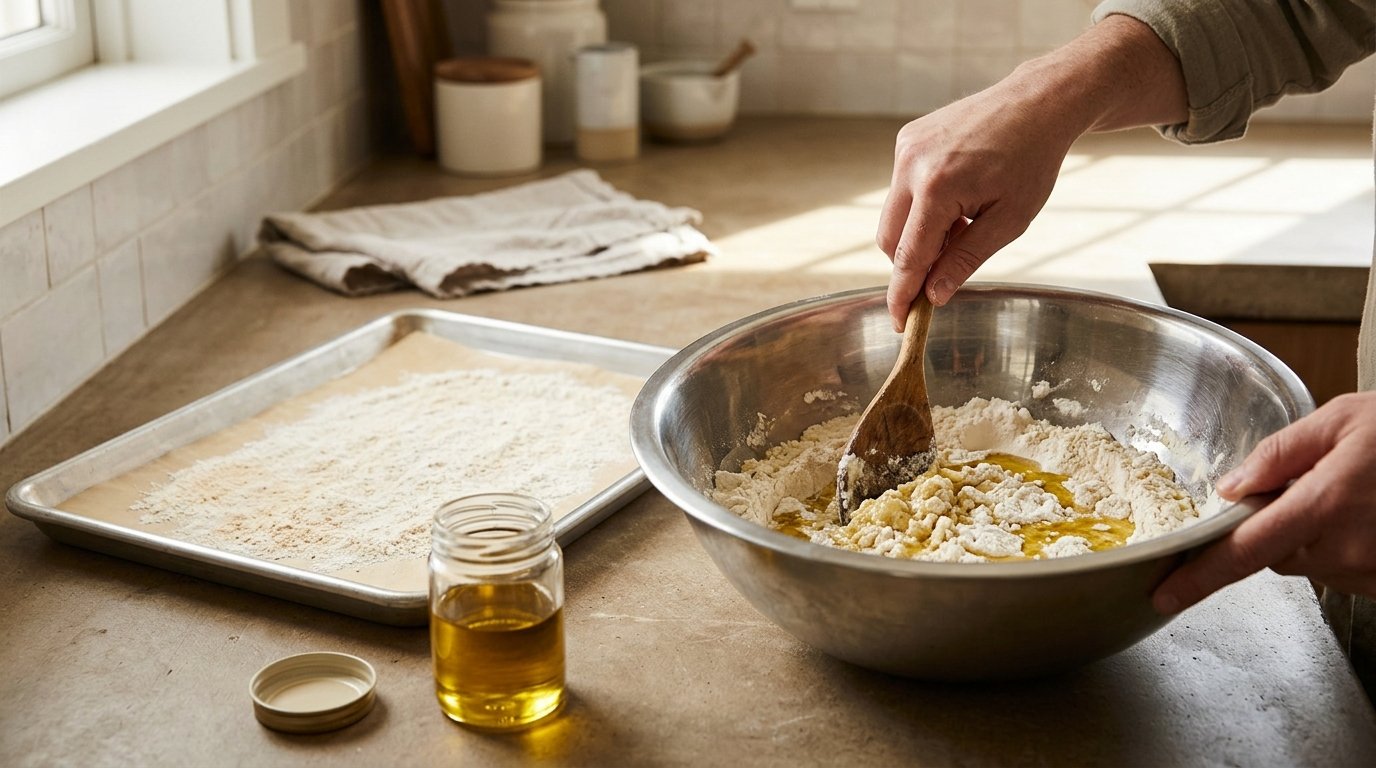
- Start at roughly eight parts flour to one part oil by volume. The base recipe most guides cite is 8 cups of flour to 1 cup of oil, and that is a starting point rather than a law. Too crumbly means oil by the teaspoon; too greasy means more flour worked through.
- Heat-treat the flour before it goes near a child. Spread it thin on a tray, warm it through, then let it cool completely before mixing. Raw flour is a raw agricultural product, so this is a food-safety precaution, not a texture trick.
- Choose the oil with the end use in mind. Food oils are the safer choice around mouths but turn rancid. Coconut oil sets hard when cold and softens in a warm room. Mineral oil is not a food.
- Mix, then correct. Squeeze a fistful. If it holds and then breaks cleanly, you are done. If it sheds powder, work in oil. If it leaves a shine on your palm, work in flour.
Gluten-free and taste-safe bases
A gluten-free version swaps wheat flour for cornstarch or a baking soda and cornstarch blend, and the result is a lighter, more powdery crumb that needs less oil than the wheat version. The taste-safe route uses blended crackers or biscuits, which is the one to choose when a child is still mouthing tools. Taste-safe means small tastes are tolerated, not that the bin is a snack.
Colour, scent and the limit of the recipe
Cocoa powder gives brown, a few drops of food colouring or a scented oil gives variation, and both can stain hands and light fabric, so keep the batch on a tray. Set expectations honestly: no ratio makes flour sand stretch. If you want stretch, sharp mold edges and a strand that pulls before it snaps, you want a binder-based sand, not a better recipe.
What Kills DIY Moon Sand in About a Month
A batch that felt perfect on Sunday can be unpleasant by week four, and the cause is chemistry and biology rather than a mistake you made.
Oxidation
Food oils turn rancid, and the stale smell arrives long before the texture looks wrong. Coconut oil batches can go off sooner in a warm room, which is exactly where a sensory bin tends to sit.
Separation
Oil migrates out of the flour and pools at the bottom of the container, leaving greasy patches below and a dry crust on top. You can knead it back together, and it will separate again.
Humidity and contamination
Flour takes up moisture from the air. In a closed warm container that means clumping, then a sour smell, then visible fuzz. In dry air the surface crusts and puffs into dust instead. Add crumbs, saliva, hair and floor dust and you have a food medium in a warm box, which is also what makes a stored bin attractive to pests.
The commercial comparison is a different failure mode
Mineral sand has no food content to rot, but it is not immune to anything. It still ends when it is contaminated or left open and walked through. IBIZA states its sand is formulated not to dry out and works in different climates, whether humid or dry, which is a durability claim about its own material and worth checking against test documentation for the batch you buy.
The claim that moon sand never dries out
The timeline is set by the oil and the flour, not by the container, and that is what the oxidation and moisture problems above predict. Moon sand does not evaporate like water, but it crusts, separates and spoils. Readers deserve that distinction before they mix five litres of it.
Safety, Honestly: Raw Flour, Mineral Oil and the Word Taste-Safe
Most recipe posts present the risk picture as a footnote. Here it is in the open.
- Raw flour is a known vehicle for pathogens. The FDA and the CDC both warn against eating raw flour for exactly that reason, and it makes a bin of untreated flour near a mouth a food-handling question rather than a craft question.
- Mineral oil is not edible. Swallowed in quantity it acts as a laxative, so it should not be the oil of choice for a child who still mouths tools.
- Food oils shorten the safe working life of a batch. Rancid oil turns the bin into a spoiled food product rather than a stale craft supply, and working fresh oil through it does not undo that.
- Taste-safe does not mean edible. It means small tastes are tolerated; it says nothing about eating a handful, and nothing about nutritional safety in quantity.
- Allergen wording deserves scrutiny. Wheat flour contains gluten, some oils are nut-derived, and an allergen-free label describes one specific formulation, not a whole category of material.
- Separate tested standards from slogans. China 3C, EN71 for Europe and ASTM for the US are the frameworks that set the requirements, and each one describes what a test covers rather than who carries it out. The export arrangement sits on top of that: IBIZA states its Magic Sand complies with China 3C, SGS, ASTM and other international safety standards, has its export testing carried out through SGS, and shares test documents on request through sales.
- Supervision still does the work no certificate can. Fine dust and small molded pieces are the practical concerns for the youngest users. For age bands and what a test report does and does not cover, read is kinetic sand safe rather than relying on a badge on the lid.
Which One for Which Setting: Toddlers, Classrooms, Sensory Sessions and Workshops
A toddler who still puts tools in her mouth and a six-year-old forming letters need different materials, and the room they play in decides nearly as much as the child does.
| Setting | Better choice | Why |
|---|---|---|
| Toddler at home, still mouthing | Heat-treated taste-safe flour batch | Ingestion risk outweighs the mess argument |
| Toddler at home, past mouthing | Moldable sand | Reuses for months, sweeps back together |
| Preschool sand table | Moldable sand | Crumbs stay in the tray across a week |
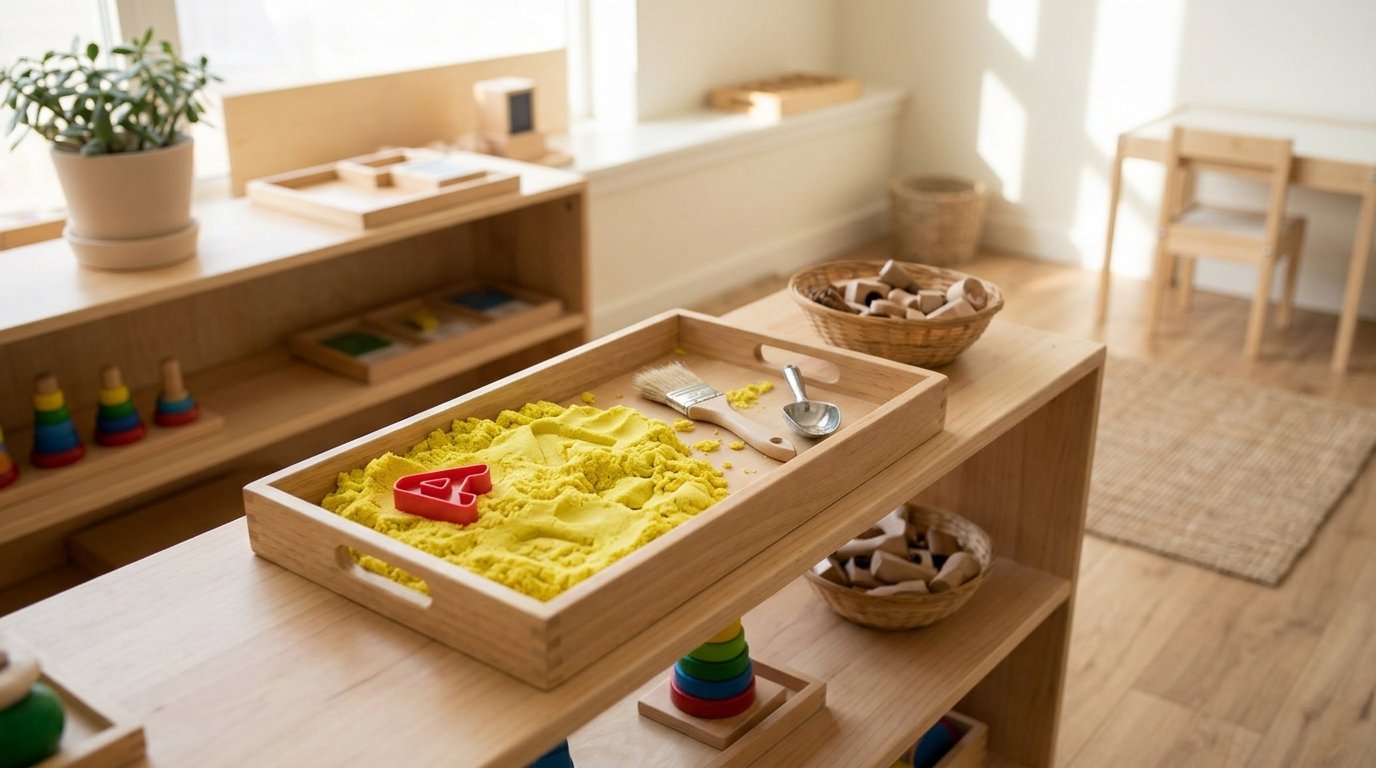
| Montessori tray work | Moldable sand | Holds fine letter and shape detail through handling |
| Calm-down corner or OT session | Moldable sand | Dense, resistive, often regulating |
| Art and craft workshop | Either, by task | Volume and texture work versus cut edges and relief |
| Outdoor sandbox | Washed play sand | Volume, drainage and weather exposure decide it |
For a tactile-defensive child, dry crumbly material is alerting and can be aversive, while a dense stretchy material gives heavy proprioceptive input and often settles a session down. That is sensory integration theory in practice, the framework occupational therapists train in, and it is the sort of reasoning a product page never mentions.
What type of sand is best for a toddler sandbox?
Washed play sand, not either indoor material. Volume, drainage and weather exposure are the deciding factors outdoors, and neither a flour batch nor a coated glass-bead sand is built for rain, leaves and a cover that comes off in July.
What is better than kinetic sand?
Nothing is universally better, and any article that says otherwise is selling something. Play sand wins on volume, sand clay wins on fine detail, and a DIY batch wins on taste-safe mouthing risk. Match the material to the job.
Containment applies to both
A shallow tray with raised sides, a mat underneath and one defined play zone cut cleanup more than any material choice. Colour planning helps too: IBIZA offers eight Magic Sand colours, grouped as warm (Pink, Red, Orange, Yellow), cool (Green, Blue, Purple) and earth (Brown), which makes it easy to stock a table without mixing everything into one grey heap.
Fixes and Storage for Both Materials
Most batches get thrown out because of one fixable problem. Scan the row that matches what is in front of you.
| Problem | Material | Fix |
|---|---|---|
| Crusty or powdery | Moon sand | Knead in oil a teaspoon at a time. Never add water, which makes paste and invites spoilage |
| Greasy or sticky | Moon sand | Work in dry flour or cornstarch; chill briefly if the batch used coconut oil |
| Sour smell or visible fuzz | Moon sand | Bin it. There is no revival for a spoiled food-based batch |
| Will not hold a shape | Moldable sand | A few drops of water massaged through, plus warmth from hands. Never bake or microwave it |
| Hair, lint, debris | Both | Pick out by hand and work the surface; washing mineral sand is a separate procedure |
| Colour transfer | Both | Keep light and dark batches in separate containers, stored apart |
| Everyday storage | Both | Airtight, cool, dry, out of sun, with water kept out |
Humidity, not time, is the main enemy of mineral sand. A tub that stays sealed and dry keeps behaving the way it did the day it was opened; the same tub left open next to a sink does not. What the lid protects is the coating on the grains and the moisture balance that lets them cling to each other. Food-based sand is the reverse: it fails on a clock no matter how well you store it.
The Practical Takeaway: Match the Material to the Job, Then Check the Label
Cost of ownership settles this decision more often than the sticker price does, and it follows the play pattern rather than the label on the tub.
Home mixing spends ingredients and labour every batch, and spoiled batches get thrown out on a short cycle. A mineral sand costs more at the start and then survives until contamination ends it, which might be months of weekly classroom use or one enthusiastic afternoon with a spilled drink. The driver is replacement frequency and labour, not the price on the shelf.
Disposal matters more than most people expect. Spoiled flour sand belongs in the bin and not the drain, because flour and oil make a paste that clogs. Mineral sand ends its life when it is contaminated, so check local disposal guidance for the material rather than assuming it is compostable.
Then use the label checklist on any tub you pick up: ingredient basis, stated standards, age guidance, and whether test documentation is available on request. A product that answers all four is easier to trust than one with a large word and no panel.
If the next question is about keeping the material usable, the guides to how long kinetic sand actually lasts and to mixing colors without making mud pick up where this comparison stops.
Frequently asked questions
How long does homemade moon sand last?
Plan on about a month in a sealed container, and less in a warm room. Food oil oxidizes and turns stale, oil separates out of the flour, and any moisture the batch picks up invites spoilage. Once it smells sour or shows fuzz, throw it out. No amount of kneading brings a spoiled flour batch back.
Can you mix moon sand and kinetic sand together?
Technically yes, and practically no. The flour coats the binder-coated grains and you lose the stretch and clean release that made the mineral sand worth buying, while the flour still spoils on its usual clock. Keep them in separate bins and let each one do the job it is good at.
Can you make kinetic sand at home?
Not really, not the version that stretches. Home recipes usually combine play sand with dish soap, cornstarch or slime-like ingredients, and they behave more like damp sand than like a binder-bridged material. The flex and rebound in commercial moldable sand come from a formulated binder and a surface treatment applied to the grains.
Is moon sand reusable?
For a few weeks, yes, if you seal it between sessions and pick out crumbs and debris. It is not reusable indefinitely. The oil goes stale, the texture separates into dry crust and greasy patches, and the batch reaches a point where mixing a fresh one costs less effort than reviving the old one.