

If you’ve ever handed a tub of magic sand to a four-year-old, you already know the first law of toddler physics: whatever goes into the hands will, sooner or later, attempt to go into the mouth.
That’s why, when buyers ask us “Is your sand safe?”, we don’t answer with adjectives. We answer with standards, test methods and report numbers. And today we want to talk about one standard that a lot of people in the toy trade still underestimate.
Myth: “The strictest toy rules live in Brussels and Washington”
For a long time this was a fair assumption. EN 71 in Europe and ASTM F963 in the United States have been the reference points for toy safety worldwide, and for good reason.
But the map has changed. On 5 October 2025, China published GB 6675-2025, a full rewrite of its mandatory national toy safety standard. It replaces the 2014 edition and takes effect on 1 November 2026. It is built on the international ISO 8124 series and benchmarked against EU and US requirements. In several places it goes further than either of them:
- Phthalates, all in one list. GB 6675-2025 restricts 10 phthalates, each to 0.1% or less. It merges China’s previous six with the phthalates restricted under EU REACH and the US CPSIA into a single combined list. In practice, one test now covers what used to take three rulebooks.
- Total VOCs, measured like indoor air. The new standard sets a limit on the total volatile organic compounds a toy releases, tested in a sealed climate chamber. Neither EN 71 nor ASTM F963 has an equivalent across-the-board TVOC limit for toys. For a product children hold close to their faces for an hour at a time, that matters.
- More chemical families under control. The standard now sets explicit limits for formaldehyde, polycyclic aromatic hydrocarbons (PAHs), azo dyes, N-nitrosamines, formamide, short-chain chlorinated paraffins and allergenic fragrances.
- Rules written for “new” toys. Slime, modelling clay and similar soft materials now have dedicated boron limits, in line with EN 71.
So, what are the differences between GB 6675-2025 and EN 71? For example, EN 71-3 controls more types of migratable heavy metals. Neither standard is superior across every metric, which is why responsible manufacturers don’t rely on just one standard.
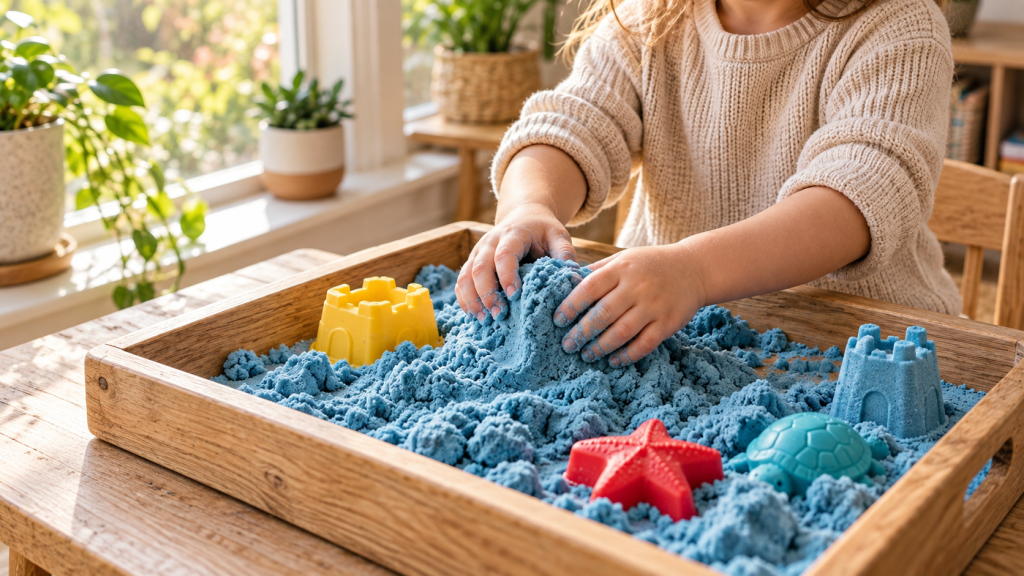
Why magic sand deserves this level of scrutiny
Magic sand looks simple: sand, a binder, a bit of colour. But from a safety point of view, it ticks almost every box that makes toxicologists pay attention:
- High-frequency contact. Kids knead, squeeze and sculpt it for long sessions, often daily.
- Easy to love, easy to ingest. No batteries, no instructions, no age barrier. Tiny grains end up under fingernails, on lips and, yes, in mouths.
- Chemistry hides in the details. Pigments can carry heavy metals. Binders and fragrances can release VOCs. And the sand itself is a mineral, so where it is mined matters.
In other words, the risk in magic sand isn’t a sharp edge you can see. It’s chemistry and material safety you can’t see. You can only control it with testing.
What about asbestos?
Following the 2025 recalls of coloured play sand in Australia and New Zealand, this is the question on every buyer’s mind, and it deserves a straight answer.
Asbestos is not something toy chemistry limits are designed to catch, and GB 6675 does not include an asbestos test. So we tested for it separately, and we didn’t stop at one bestseller: every product in our range—washed sand, magic sand, space sand and cotton sand—has been tested for asbestos by Shenzhen General Standard Testing Services Co., Ltd.
Result: no asbestos detected in any of our products. The reports are available on request.
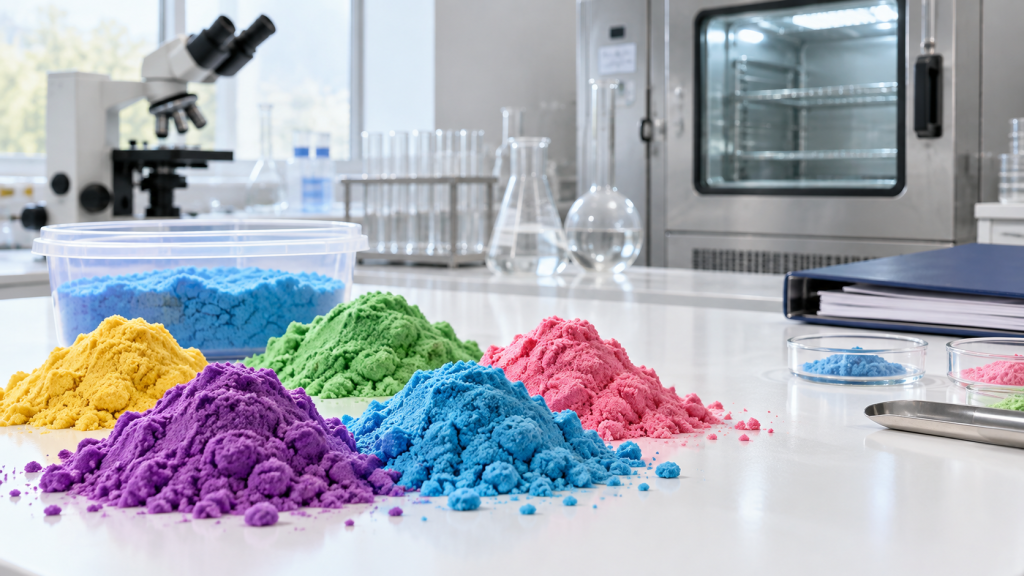
Our results, in plain numbers
- 100% pass on the full GB 6675-2025 test suite: basic requirements, mechanical & physical, flammability and migration of specific elements. Tested by Shenzhen General Standard Testing Services Co.,Ltd, Report No. WT20103261195764WT2, dated September 10, 2026.
- EN 71-1:2014+A1:2018 / EN 71-2:2020+A1:2025 / EN 71-3:2019+A2:2024, Report No. RGST260714128R01 (revised August 7, 2026).
- ASTM F963-17 / ASTM F963-23, Report No. RGST240709108.
That means the submitted samples passed the specific tests listed in the reports for the Chinese, European and American standards.
The bottom line
Toy safety isn’t a contest between countries. It’s a contest against risk. The smartest move is to test against the toughest parts of every major standard, and publish the evidence.
So go ahead: let them squish it, shape it, smash it and build it again. We’ve done the boring part in the lab, so the fun part can stay fun.